
Published : 2026-01-20
Cantonese is one of the iconic representatives of China's Guangdong culture. But have you ever wondered whether your Cantonese is spoken accurately? And have you considered that many of its terms are related to ancient allusions?
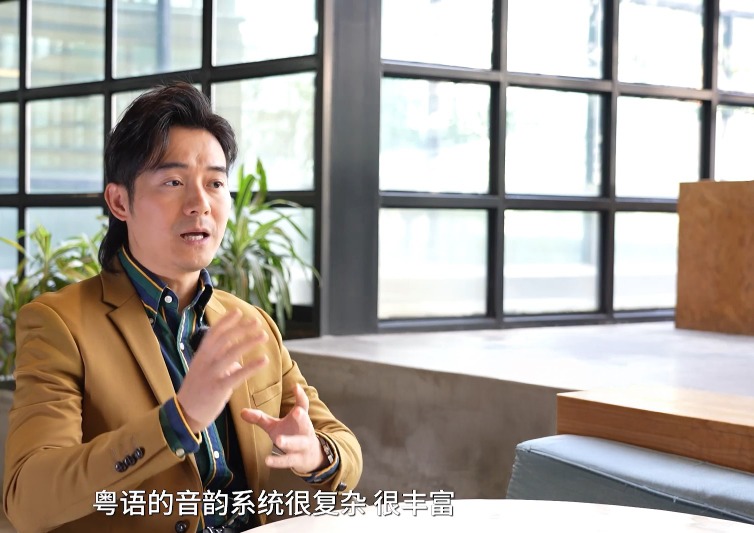
Zhang Chi, a passionate advocate of Cantonese culture has dedicated himself to popularising knowledge about the language. He runs an account titled "Zhang Chi You Dao: Cantonese Poetry Recitation" (張弛有道‧粵語讀詩) where he shares his experiences and insights as a host and Cantonese teacher.
Zhang Chi makes Douyin videos to share his insights on Cantonese
Zhang Chi was born in south China's Guangzhou and graduated from Guangzhou University with a major in Broadcasting and Hosting, focusing on both Cantonese and Mandarin.
In 2005, he became a news anchor for Guangdong Radio and Television, hosting programmes such as On-Time Report (正點報道), Today's Finance (今日財經), Entertainment Frontline (娛樂前線), and Asian New Power (亞洲新勢力).

Due to his work, the more Zhang Chi came into contact with Cantonese culture, the more he enjoyed researching Cantonese, its initials, finals, tonal values, and its history. As a result, he discovered that there is a great aesthetic beauty in reading ancient poetry in Cantonese.
In 2019, with the rise of Douyin, the Chinese version of TikTok, Zhang registered the account "Zhang Chi You Dao - Reading Poems in Cantonese", attempting to share his understanding of Cantonese culture and insights from his experience as a Cantonese anchor through short videos.
He posted content covering standard Cantonese pronunciation with its "nine tones and six contours" (九聲六調), recitations of classical poetry in Cantonese, and explanations of Cantonese colloquial expressions. Within a year, the account had accumulated over 600,000 followers.
Zhang Chi has stated that the phonological system of Cantonese is very complex and rich, having inherited a mode of expression from people of the Tang and Song dynasties.
He also pointed out that poetry of the Tang and Song dynasties should be read in dialect, as southern dialects like Cantonese, Hakka, Teochew, and Shanghainese have preserved many pronunciations and words of Old Chinese from the Tang and Song dynasties, and even from the Zhou dynasty (1046–256 BC), the Spring and Autumn and Warring States periods (770-476 BC), and the Jin dynasty (1115-1234 AD).
Read more: A small vendor in HK donates 15 mln over 40 years for Chinese Mainland education
Zhang Chi explains that Cantonese vocabulary comes from ancient times
He pointed out that learning Cantonese is like conversing and engaging with the world through ancient Chinese. For example, the Cantonese phrase for "having a dream while sleeping", expressed as "seeking the Duke of Zhou" (搵周公), actually comes from an allusion to Confucius.
The story goes that Confucius frequently dreamt of the Duke of Zhou imparting knowledge about rites and ceremonial systems to him.
Later, as Confucius was older, he told his disciple, "The Duke of Zhou has not come to me for a long time". His disciples recorded this, and thus, Confucius sleeping and dreaming became known as "seeking the Duke of Zhou".
There is another Cantonese phrase, "as messy as the Seven Kingdoms" ("七國咁亂"), which is used to describe a completely chaotic and very messy situation.
During the Warring States period, wars frequently broke out among the seven kingdoms, and many ordinary people fled from the Central Plains Region to the south. When the people of Lingnan in the south asked these refugees, they would say: "The Central Plains Region are as messy as the Seven Kingdoms".
It is evident that many modern expressions are derived from classical Chinese allusions, which is very interesting.
In his videos, Zhang Chi also frequently addresses and corrects misconceptions about Cantonese.
In 2022, in a video related to the CCTV Spring Festival Gala, Zhang Chi pointed out some misunderstandings and inaccurate language in the crosstalk show "Happy Dialects" (歡樂方言) that evening. The five-minute video received nearly 20 million views and over 260,000 likes.
Subsequently, a Guangzhou municipal government department awarded Zhang Chi the title of "Guangfu Culture Promotion Ambassador".
Read more: "Dianxi Xiaoge" creates videos sharing rural life in Yunnan
Zhang Chi became an online Cantonese teacher
In 2023, Zhang bid farewell to his career as a television news anchor and determined to fully devote himself to disseminating Cantonese knowledge and inheriting Cantonese culture through videos.
Besides reciting poetry in Cantonese, he collaborates across fields such as historical sites, cuisine, celebrities, classic films and television, songs, and Cantonese opera in the Guangdong-Hong Kong-Macao region, to let netizens feel the charm of Cantonese culture and also to expand his influence.
"When I was a news anchor, I mainly reported other people's stories. I wanted to open up a channel to tell my own story, the story of Cantonese and traditional culture." Zhang Chi said when talking about why he made the career change.



The fans of Zhang Chi come from all over the world. Some are descendants of Chinese people whose parents or grandparents emigrated to countries like the United States, Canada, and Australia. They learn Cantonese because they want to communicate more with their elders, and also to carry on the culture passed down from their ancestors.
He also has some fans who came to the Guangdong–Hong Kong–Macao Greater Bay Area (GBA) for work or study, and want to learn Cantonese to make it easier to get to know friends, colleagues, or clients, which is beneficial for their future development.
There are also fans who like Hong Kong films and Cantonese songs, who want to be able to understand the films and songs by learning Cantonese.
Zhang Chi actively promotes Cantonese culture both online and offline. He recites ancient poems, corrects lazy pronunciation, explains allusions, and more, gently reminding us to pass on the linguistic aesthetics of Cantonese from generation to generation.