Published : 2025-10-30
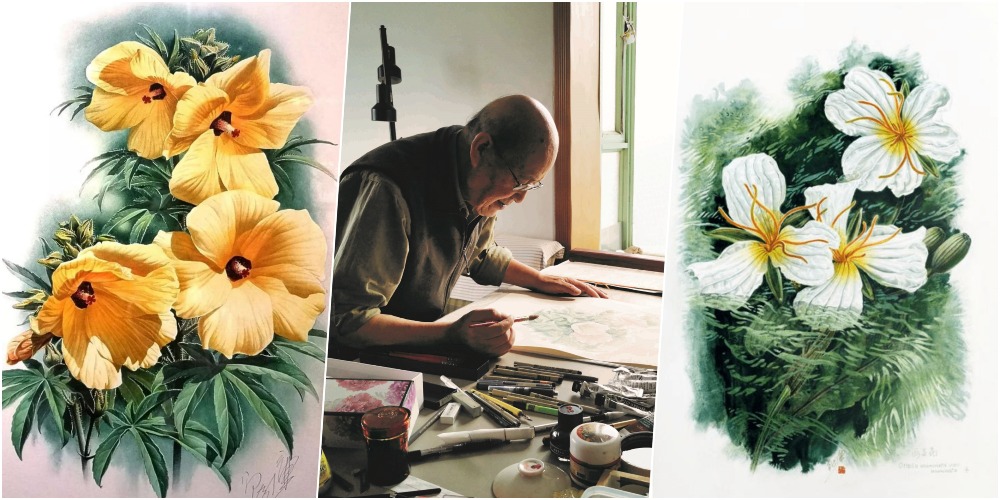
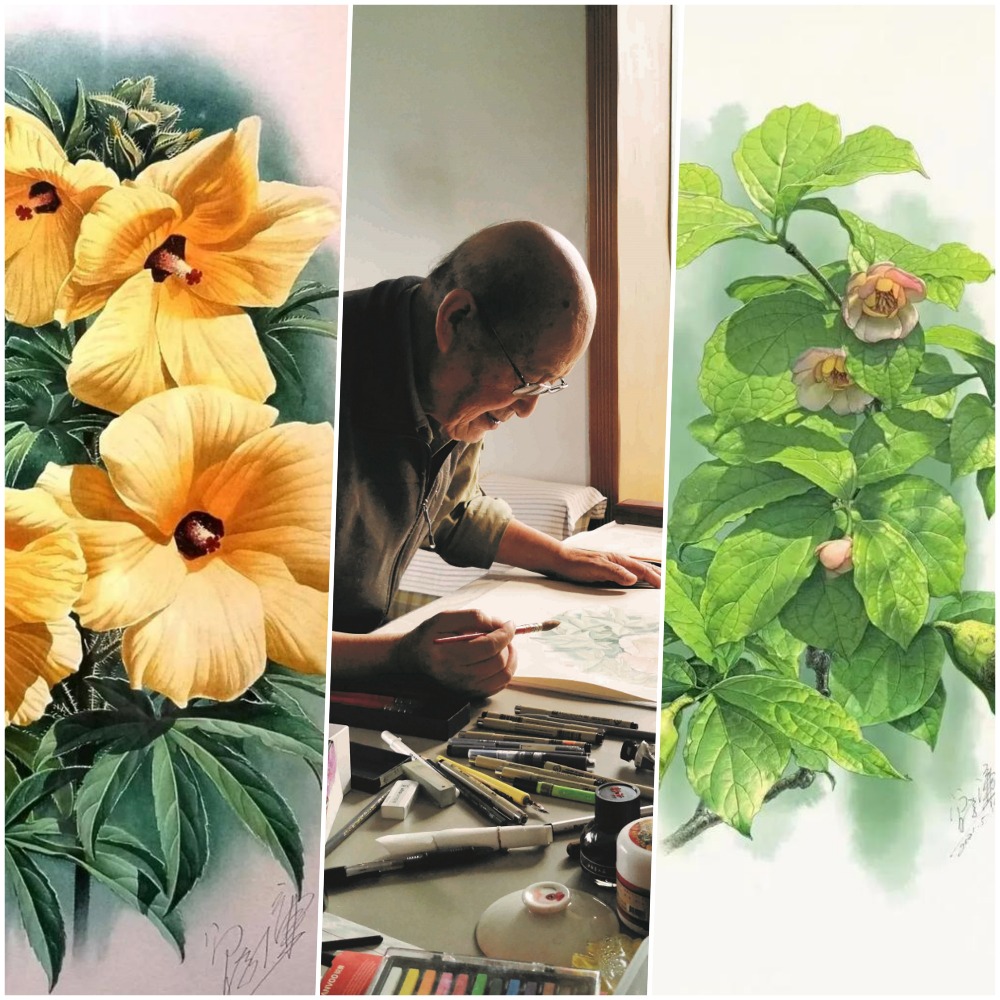
After 45 years of compilation, recording information on over 30,000 plant species and accompanied by more than 9,000 illustrations... the Flora of China is regarded as the most authoritative "ID card" for plants in China. And Zeng Xiaolian, known as "China's top botanical painter," was the soul behind the illustrations for this monumental work.
Choose one thing, dedicate a lifetime. Zeng Xiaolian spent his life communing with the mountains, rivers, and flora, painting portraits of all natural beings.
He said he is untroubled by the cycles of life and death, stating, "I came into this world to do this, and I will leave having done it."
From apprentice to craftsman
Back in the 1950s, in order to understand the "base" of biological resources, China entered a period of biological resource census.
The state issued the compiling tasks of Flora of China, Fauna of China, and Spore Flora of China. Among them, the Flora of China is equivalent to writing biographies and portraits for Chinese plants, and it is a national-level major project.
When the project started in 1959, 20-year-old Zeng Xiaolian had just been admitted to the Kunming Institute of Botany, Chinese Academy of Sciences. He didn't go to college and is not a professional graduate.
However, since he loved painting from a young age, his superiors saw that he could draw and arranged him to the botanical classification laboratory to be responsible for plant specimen illustrations.

Drawing a plant specimen is equivalent to performing an autopsy with a brush. It should accurately reproduce the structure, state, and details of the plant.
Zeng started as an apprentice, and for the first few years, his daily routine was the same: checking data and specimens at the specimen house, sketching in the botanical garden, and learning illustration techniques in the library. It sounds boring, but it laid a solid foundation.
A few years later, by a chance, Zeng visited the virgin forest in Xishuangbanna, Yunnan. This visit completely changed his conception.
He realized that painting plants not only needs to look accurate but also needs to show its vitality, as he summarized in interviews many years later: presenting the state of vitality is a higher standard beyond accuracy.

“Facing a live species, the first impression of its life state is extremely important. The desire to survive and strong expression can't be depicted without actual observation, it's nearly impossible. The state of vitality is a higher standard than accuracy." - Zeng Xiaolian
Since then, Zeng would first look at photos or specimens for a surface-level understanding of the plant. Then he would go to its original habitat to observe its growth and feel its life state.
Over the years, he traveled all over China and even crossed American nature reserves twice to observe plants personally.
He painted for 45 years until the Flora of China was completed in 2004. The entire compilation consists of 80 volumes and 126 books and is one of the largest and richest collections worldwide.
Zeng Xiaolian and his team of 160 painters have accomplished over 9,000 plant illustrations in the book.

Read more: Post-90s returns to hometown to make paper umbrellas
From craftsman to painter
Flora of China is a monumental book, but the illustration team did not have much desires and has been silent over the years.
By the time the compilation was finished, photography had become quite popular. The relevance of scientific painting seemed to have faded, and some members of the team had switched to another painting style, and some even changed their career.
However, Zeng does not believe that photography can replace scientific painting: "Compared to photography, scientific painting can highlight the characteristics of a species more. Different species of the same genus might have very minor differences.
Photography can present the whole view of a species, but the characteristics might not be that obvious at first glance. Scientific painting, on the other hand, emphasizes presenting the characteristics of the species making them immediately visible."
Therefore, not only did he not think of giving up, but he felt that there were so many more things he wanted to draw.
For him, the completion of the Flora of China is a watershed: in the past, painting for the compilation required accurately expressing plant characteristics; in the future, it is about venturing out of research institutes to draw works that are popular among the public in order to attract more attention to natural science.

Inspired by Xu Beihong's concept of "combining Chinese traditional naturalism and Western realism," Zeng Xiaolian feels that realistic scientific painting should also incorporate elements of Chinese painting.
Consequently, over the next seven or eight years, Zeng devoted himself to studying Chinese painting and exploring a new style.
"Every flower has its own methods, which are a strong manifestation of survival instinct. It is the most vivid, the most peculiar, and sometimes truly beyond human imagination."— Zeng Xiaolian
In the following decades, Zeng Xiaolian created illustrations for more than 50 popular science books; his works have won numerous awards and have been exhibited in many countries such as the United States and Japan. His artworks have also been used multiple times on official postage stamps by China Post.
Zeng Xiaolian affirmed the irreplaceability of hand-drawing. Some have praised him for making flowers bloom on paper, not just drawing the "form" of plants, but their "spirit" and "soul".

From painter to master
In 2019, 80-year-old Zeng Xiaolian was diagnosed with lung cancer. The risk of surgery was too high for elderly people, but he would rather take the risk than undergo chemotherapy: "Once you start chemotherapy, your hands tremble, you can't paint, and life loses meaning."
After the resection surgery, he only had three lung lobes left, but as long as he could paint, there was something to look forward to.
Three years later, the Zeng Xiaolian Art Museum opened in Kunming, Yunnan. This is China's first personal art museum with biological and botanical paintings as the main exhibition.
It showcases his representative works and creative manuscripts over the past 60 years. The album Extreme Life of Grass and Wood: Zeng Xiaolian and His Museum Paintings featuring 300 pieces of his work was also released on the same day.

After decades of accumulation, from an unknown apprentice, Zeng Xiaolian has become the “No. 1 of Chinese Botanical Painting”, a well-deserved master.
Now, at the age of 84, Zeng still works at the desk for 8 hours every day, racing against time.
"Don't think that because you're old, there's reason to stick to what you're familiar with, there's no need. If you feel you can still do it, why not do it? If you can't do it, others will, it's good even just to start it." - Zeng Xiaolian

Every flower, grass, bird, and tree are stories and depict the world. Zeng Xiaolian has painted this way his whole life: "When I was young, it was a hobby. In work, it was responsibility; after retirement, it became obsession and habit I couldn't change."
He also encourages more younger generations to continue drawing: "This painting style has no barriers or factions. Many styles ask who your patriarch is. We don't have that; our patriarch is nature. So as long as you have some courage and silently communicate with nature, it will accompany you for a lifetime."