
Published : 2025-12-12
Earthquakes are unavoidable, so it is particularly important to do disaster reduction and prevention. China has created the world's most powerful earthquake early warning project, providing extremely important seconds-level warnings to save lives and reduce damage to the greatest extent possible when an earthquake occurs.
How does China's national earthquake early warning project operate? Are there any practical results?
Early warning and prediction are very different

First, it must be stated that although earthquake prediction(地震預報) and earthquake early warning(地震預警) differ by only one word in Chinese, they are two different concepts.
Earthquake prediction refers to forecasting the possible time, location, and magnitude of a future earthquake based on observation and analysis before it occurs.
With current science and technology, it is impossible to accurately predict earthquakes, for example, down to a specific day. Experts can only calculate the probability of an earthquake occurring within a rather long period.
For example, the Japanese government predicts that the probability of a major earthquake occurring there in the next 30 years is approximately 60% to over 90%.
Unlike the concept of predicting the future, earthquake early warning only begins from the moment an earthquake occurs.
In short, when an earthquake occurs, it simultaneously generates Primary waves(P waves) and Secondly waves(S waves). P waves, which cause the ground to vibrate up and down, travel at about 6 kilometres per second and are less destructive; S waves, which cause back-and-forth and side-to-side vibrations, travel at about 3.5 kilometres per second but are more destructive.
P waves are faster than S waves
Because P waves always outrun S waves, experts can quickly determine data such as the earthquake's magnitude and focal depth by capturing the P waves via monitoring stations in various locations.
By leveraging the fact that electromagnetic waves travel faster than both P waves and S waves, they can issue early warning information to the public or relevant departments before the S waves arrive in a certain area.
The most basic operating principle of China's earthquake early warning project and similar systems in other countries is the use of this speed difference.
How much time is there to react from when the public receives the early warning information to when the S waves arrive? This is affected by factors such as the distance from the epicentre. The farther the distance, the slightly longer the warning time will be.
What Chinese experts are striving for is for key warning areas to have from a few seconds to several tens of seconds.
Does knowing about an earthquake a few seconds in advance have a practical effect? Absolutely, and it is very crucial.
Read More: China has active volcanoes? 14 of them! This one is the most dangerous.....
A 10-second early warning reduces casualties by 39%

With just a 3-second early warning, people can perform life-saving actions, such as ducking under a table or into a corner; with 5 seconds, they can evacuate from a single-storey building to the outdoors.
Research figures cited by the media are more intuitive: a 3-second warning time can reduce casualties by 14%, a 10-second warning can reduce them by 39%, and a 20-second warning can reduce them by as much as 63%.
In addition, a few seconds also provide an opportunity for high-speed railways, chemical plants, nuclear power stations and other facilities or sites to take emergency measures, such as shutting down nuclear reactors, to avoid further disasters.
Of course, capturing seismic waves, measuring data, and then issuing an early warning in an extremely short period of time is technically very difficult, and requires a dense network of seismic monitoring stations, as well as a high-speed, integrated, and complex system.
China began research on a nationwide earthquake early warning system in 2009. As everyone will remember, in the preceding year of 2008, an 8.0 magnitude earthquake occurred in Wenchuan, Sichuan, causing major casualties and destruction.
In 2018, the national earthquake early warning project was fully launched, following the principle of "building, applying, and improving simultaneously", and has already achieved practical results during this period.
On 5 September 2022, a 6.8 magnitude earthquake occurred in Luding, Sichuan, and authorities issued an early warning message 6.2 seconds after the quake, providing a seconds-level early warning to 1.5 million people in the area surrounding the epicentre.
20,000 monitor stations covering 1/4 of the country's territory

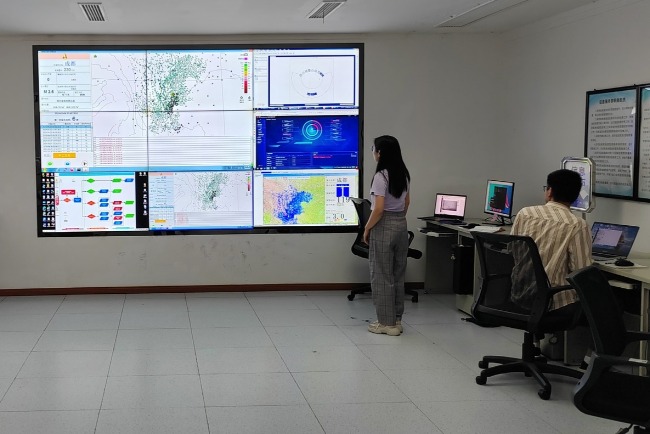
As of July 2024, the national earthquake early warning project has passed its completion inspection. By this time, the entire system had established five major technical systems, including observation, data processing, and emergency earthquake information services.
The system is equipped with 33 early warning centres and nearly 20,000 monitoring stations of various types, covering 2.4 million square kilometres, which is approximately 1/4 of the country's land.
Under the operation of a fully automated processing system, five key early warning zones, including North China, the southeast coast, the North-South seismic belt, the central Tianshan Mountains in Xinjiang, and the area surrounding Lhasa in Xizang, have developed the capability for seconds-level earthquake early warnings.
Experts point out that the national earthquake early warning project is already the world's largest earthquake early warning system.
Compared with countries that built earthquake early warning systems earlier, such as Japan, Mexico, and even the United States, China's warning coverage area is larger, its timeliness is stronger, stability is better, and it serves a larger population.
Finally, how are the early warning messages issued by the authorities transmitted to the public? In fact, it is mainly through channels such as mobile phones, radio and television.
What is quite unique is that many brands of mobile phones and televisions in the Chinese Mainland have a built-in earthquake early warning function, which can issue different messages or audible alarms depending on the severity of the impending earthquake.