Published : 2026-01-02
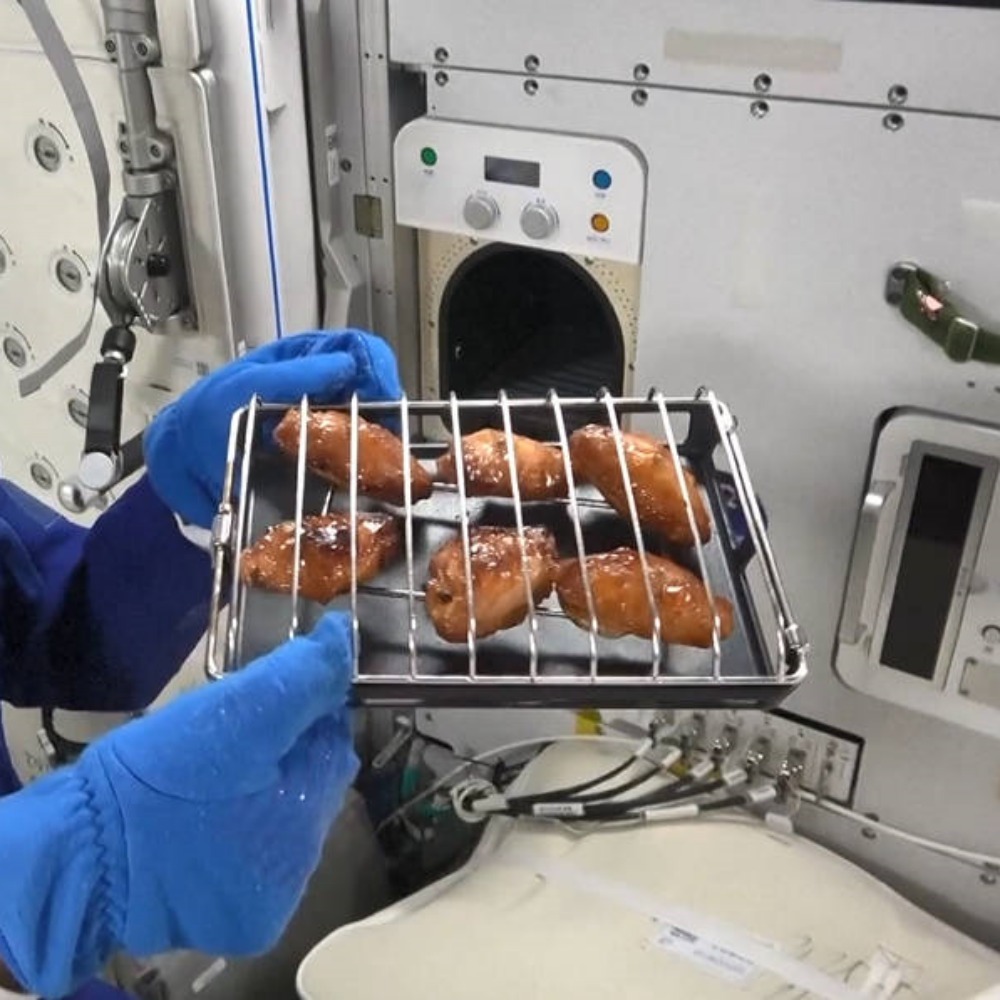
The taikonauts of Shenzhou-21 got to eat delicious freshly roasted chicken wings and steaks in the space station. This world's first space oven has enabled the on-orbit cooking and baking of astronaut food.
Such delicious, freshly cooked food is a world apart from the ready-to-eat food that China's first taikonaut, Yang Liwei, ate in 2003. Over twenty years passed, what kind of changes has Chinese space food undergone?
Shenzhou-5|Ready-to-eat food requiring no heating
During his Shenzhou-5 mission in 2003, China's first taikonaut, Yang Liwei, ate cold, ready-to-eat eight-treasure rice, Kung Pao chicken, and mooncakes within 21 hours.
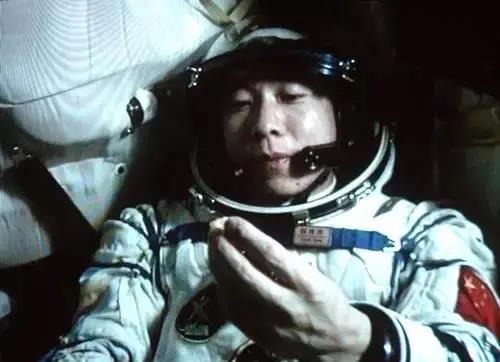
Early manned spaceflight was in its initial exploratory phase, with short flight times, limited material carrying capacity, and facilities and equipment for eating and drinking that were not yet well-developed. Therefore, space food had to be light in weight and small in volume, such as dehydrated and ready-to-eat foods.
At this stage, the variety of space food was limited, the texture, taste, and eating experience were relatively poor, it could only meet the astronauts' need for energy replenishment, and could not be considered delicious food at all.
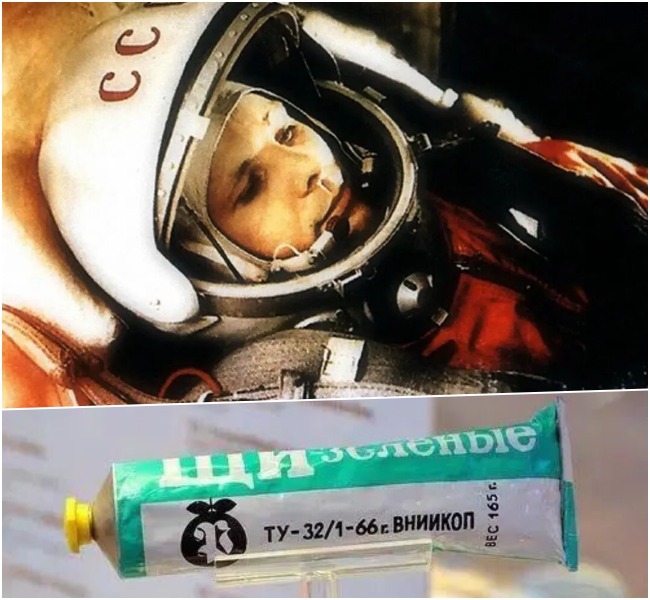
Shenzhou-6 to Shenzhou-10|Heated food and personalised food
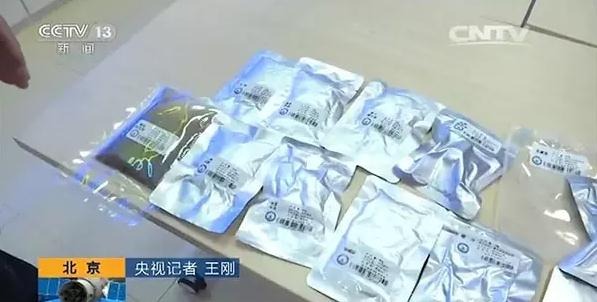
In 2005, the Shenzhou-6 crewed spacecraft was equipped with a food heater, which allowed astronauts to eat hot meals in space for the first time. Rehydratable vegetables and freeze-dried fruits were also added.
As space exploration deepened, China's research into space food technology also continuously developed. After solving the "how to eat" problem, the focus shifted to "what to eat". Space food was no longer limited to traditional dehydrated foods, but instead placed more emphasis on variety, nutritional balance, and the dining experience.
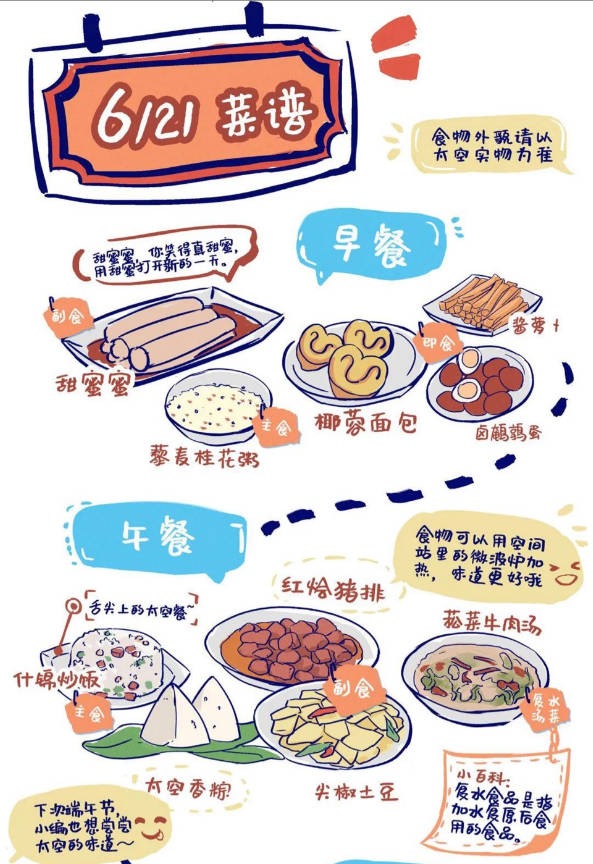
In Shenzhou-7 mission in 2008, the variety of food items had increased from over 40 to more than 80.
For the Shenzhou-10 mission in 2013, the biggest difference in space food compared to before was that it could be personalised according to the taikonauts' tastes. From meeting nutritional needs to accommodating dietary preferences, the astronauts' dining experience was further humanised.
Shenzhou-12 to Shenzhou-14|Fresh fruit sent into space
In 2021, Shenzhou-12 successfully sent fresh apples into space, meaning that astronauts were no longer limited to only eating freeze-dried fruit. Apples were chosen not only because they are nutritious and can be stored for a long time, but also because they do not need to be peeled and have little juice.
Shenzhou-14, on the other hand, chose for grapes because they are seedless, more convenient to eat, and produce less kitchen waste.
During the introduction of these fresh fruits, China's scientific research team also faced multiple challenges. How to preserve the nutritional content of food in a microgravity environment, and how to ensure the freshness of these foods during transit, are all problems that need to be solved.
As taikonauts spend increasingly longer periods in space, the requirements for food preservation equipment on the space station are becoming higher and higher, while researchers are also exploring the possibility of self-sufficient on the space station.
Read more: Tianzhou-6 launch delivers 'express package' to China's space station, including 70 kg of fruit
Shenzhou-14|Self-sufficient space garden
In 2022, on Shenzhou-14, taikonauts successfully cultivated plants such as lettuce, wheat, and dwarf tomatoes in the space garden, using long-acting controlled-release fertiliser and microporous water-guiding technology to achieve an effective supply of water and nutrients in microgravity.
The taikonauts tasted fresh lettuce they had grown in space for the first time, providing an important source of fresh food for future long-term stays on the space station.
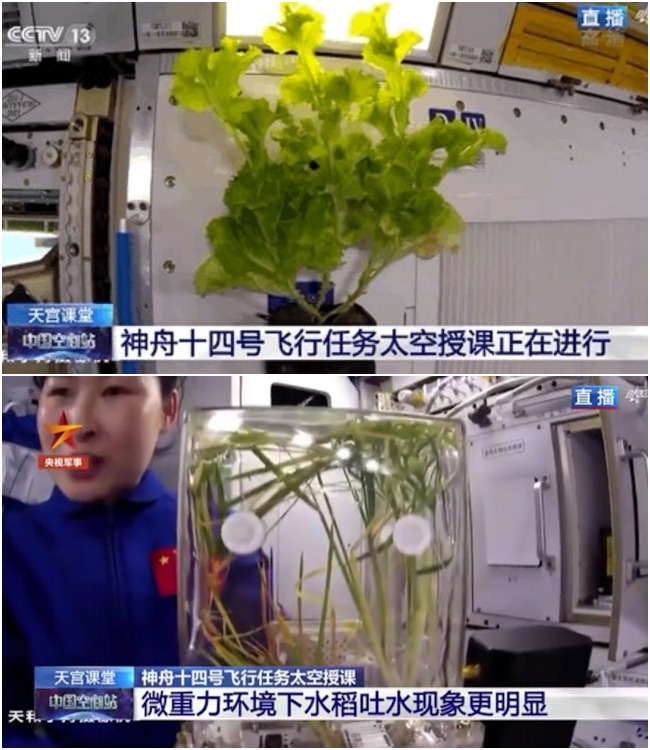
The plants in the space garden can absorb the carbon dioxide produced by the taikonauts through photosynthesis, produce oxygen, and to some extent, purify the environment of the sealed space station, obtaining fresh air.
Shenzhou-21|World's First Space Oven, Freshly Roasted Chicken Wings and Beef Steak
In October 2025, the astronauts of Shenzhou-21 ate freshly roasted chicken wings on the space station for the first time. They took the marinated chicken wings out of the packaging, secured them on the skewer rack of the baking tray, then placed them in a hot-air oven to roast at 180℃ for 28 minutes. Finally, a plate of sizzling, 'cosmic-grade' roasted chicken wings was made.
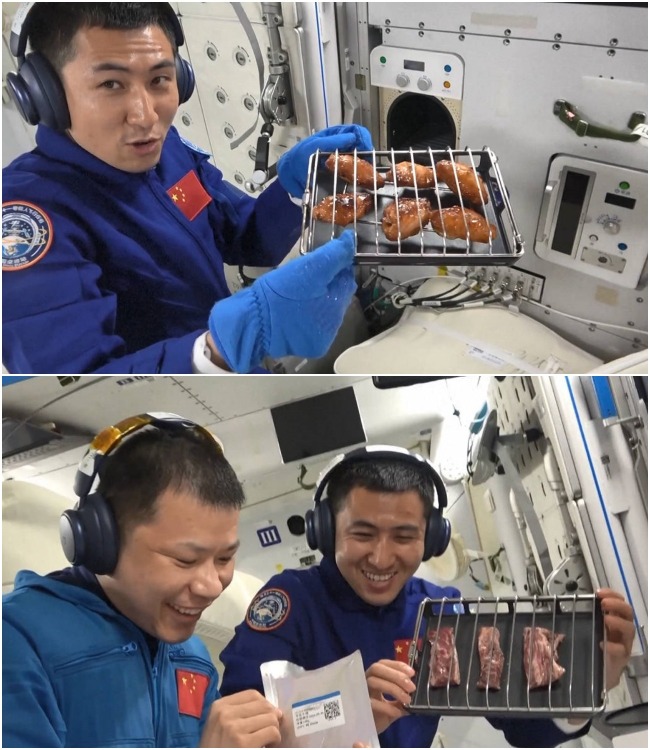
How is this special space oven different from ovens on the ground? It is the world's first space oven.
Firstly, through temperature control technology, multi-layer filtration and other techniques, it achieves oil-fume-free processing during roasting, meeting the space station's oil fume emission standards.
Secondly, its purification device and the entire machine must undergo rigorous testing and can operate reliably and continuously 500 times.
While completing scientific missions, the quality of life for Chinese taikonauts in space has been continuously improving. From mooncake to sizzling space-roasted wings, the changes on the taikonauts' menu also demonstrate the process of manned spaceflight technology becoming more refined and human-centred, as well as the confidence and strength of China's aerospace in self-reliance, innovation, and surpassing others.
Read more: China Aerospace|Stationed in Tiangong, What Fruits Can Chinese Astronauts Eat?